Defeating Legal Threats: The AI-Powered Approach
It hits you like a virtual sledgehammer. An email appears with a subject line that makes your stomach turn: "LEGAL NOTICE: Demand for Payment" or "LEGAL: Immediate Cessation Required." Your mind abruptly switches from business planning and growth strategies to a single, frightening figure. A claim seeking $50,000, $100,000, or higher amounts for a claimed intellectual property infringement or a previously overlooked liability. Your first impulse is to contact an attorney, but this reaction is soon accompanied by a second wave of anxiety when you hear the retainer fee: $10,000, $15,000, or up to $25,000 for initial representation. For many small business owners, this presents an impossible decision-an option between a devastating financial agreement and a budget-breaking legal conflict.
Consider a third possibility? What if you could fight back intelligently, strategically, and affordably? For more and more entrepreneurs, this alternative approach is now possible through AI legal defense. This isn't about replacing lawyers entirely, but about changing the rules of the game. It's about using powerful technology to evaluate challenges, create defenses, and comprehend your legal standing before spending a single dollar on legal fees. This shows how entrepreneurs are fighting back on legal bullies, cutting down on substantial legal costs, and discovering the strength to protect their enterprises in an environment of growing legal challenges.
Vital Points
- The Power Dynamic is Shifting: AI tools are making it possible company leaders to handle common legal issues themselves, decreasing dependency on expensive legal counsel for early defense phases.
- Understanding is Your Greatest Shield: Most legal threats targeting small businesses are designed to intimidate and typically rest on weak legal foundations. Knowledge of basic copyright law and debt validation procedures serves as your strongest defense.
- AI as a Research Assistant: AI systems can review legal paperwork, identify weaknesses in claims, and research relevant case law in a fraction of the time it would take a human, reducing your legal costs substantially.
- Financial Considerations are Key: With standard attorney retainers starting from $10,000-$25,000, AI-powered educational platforms provide a budget-friendly preliminary protection option at a significantly lower price point.
- Understanding When to Seek Professional Assistance: Artificial intelligence is a helpful resource for preliminary work and first steps, but it is not meant to be a replacement for a licensed attorney concerning active litigation or complex legal matters.
Navigating the Legal Landscape for Small Business Owners
Being a small business owner means a continuous juggling act. You end up being the executive, marketing specialist, personnel manager, and often the cleaning staff. The last thing you can afford is legal trouble in your business journey. However, the modern business world is a legal minefield. Recent data from 2023 indicates that U.S. small businesses face costs of $160 billion yearly due to lawsuits. This isn't just about high-profile legal cases; these are the common legal threats that steadily consume business funds.
The Growth of the Legal Bully
Many legal threats aren't focused on justice; they are fundamentally a numbers game. Aggressive collectors, predatory firms, and copyright trolls dispatch thousands of demand letters, understanding that a certain percentage of recipients will be too scared or too uninformed to fight back. They rely on the fact that legal representation expenses typically exceed than the payment they're seeking. This produces a perverse incentive to settle, regardless of whether the case is valid. These organizations function as legal bullies, utilizing intimidation as their main tactic.
Major Challenges for Business Owners
While legal complications can come from any direction, a few common issues consistently impact small companies:
- Copyright Infringement Claims: These claims are typically connected to visual content used across business websites and blog posts. The majority of these claims are automated and sent without any human review of context or fair use considerations.
- Debt Collection Notices: You might receive notices about expired, contested, or even invalid debts. Debt collectors usually acquire debts for minimal costs and employ forceful methods to recover the entire balance.
- Cease and Desist Letters: Such formal notices can cover a broad spectrum of legal issues, including intellectual property conflicts and contractual breaches. They are frequently used to pressure competitors or discourage critics.
- Banking and Payment Disputes: Disputes with banking providers or payment processors can block accounts and disrupt business, forcing business owners to take defensive measures.
For entrepreneurs facing these challenges, each situation feels like a complete crisis. The reality, however, is that many of these situations are essentially education and preparation matters, not litigation problems.
Understanding Legal Defense Costs: Traditional Methods Falling Short for Small Businesses
The typical process for handling a legal issue is clear-cut: you retain an attorney. For big companies with corporate legal staff and deep pockets, this is a standard expense of business operations. For a small company, it's a significant financial strain. The average legal spend for a small enterprise is around $13,300 each year, but this number can rise significantly when litigation is involved, with expenses ranging from $3,000 to more than $150,000.
The Truth About Retainers
The most significant immediate obstacle is the attorney retainer. A retainer is basically an initial deposit for legal services, and when it comes to litigation, it's seldom less than five figures. This creates what is often called the "retainer trap." An entrepreneur could get a claim for $8,000. An attorney estimates a $15,000 retainer to defend against it. Financially speaking, the "logical" option becomes settling for the $8,000 payment, even if the allegations are unfounded. This is the approach that aggressive plaintiffs count on. They've deliberately priced their claims to be just below the initial investment to fight back legally.
Misaligned Incentives
Moreover, the traditional legal approach is structured on billable hours. Lawyers get paid more when cases take longer. While ethical lawyers aim for efficiency, the framework naturally incentivizes prolonged cases and complicated proceedings. This creates a direct conflict with what matters to small enterprise owners, who require fast, affordable, and effective resolutions. The key priority for the business owner is to solve the problem, not to become involved in a prolonged and expensive legal battle.
AI's Transformation of Legal Protection for Business Owners
For decades, the steep pricing of legal assistance generated a significant void in the market. No practical solution existed for entrepreneurs who couldn't afford an attorney but refused to give in to unsubstantiated accusations. Artificial intelligence is presently closing that gap. It's not a perfect answer, but it is a powerful tool that creates equal opportunities by significantly decreasing the financial and temporal requirements associated with the crucial first phases of mounting a legal response.
AI as a Super-Powered Paralegal
Imagine AI similar to a paralegal equipped with the capability and photographic memory to process thousands of pages per minute. Let's explore its applications:
- Document Analysis: AI systems can thoroughly review a demand letter or legal complaint and quickly pinpoint critical details, such as specific allegations, relevant legal codes, and monetary claims. The AI evaluates the content to extensive case databases to discover common issues and deficiencies.
- Legal Research: In place of an attorney dedicating extensive periods (at $300+ per hour) examining legal cases, artificial intelligence can scan through legal repositories and deliver applicable case law in seconds. The AI can identify data on consumer protection laws, fair use guidelines, or debt validation requirements pertaining to the matter.
- Drafting Assistance: AI is capable of preparing first reply documents. After inputting the claim details and applicable legal standards, it can produce a well-crafted, well-structured reply that establishes your position and signals to the other party that you will defend your position firmly.
This marks a significant change. The preliminary review and assessment, which typically runs thousands in legal fees, can be handled with a significantly lower expense in an AI-enhanced educational tool.
A Step-by-Step Guide to the AI Legal Defense Framework
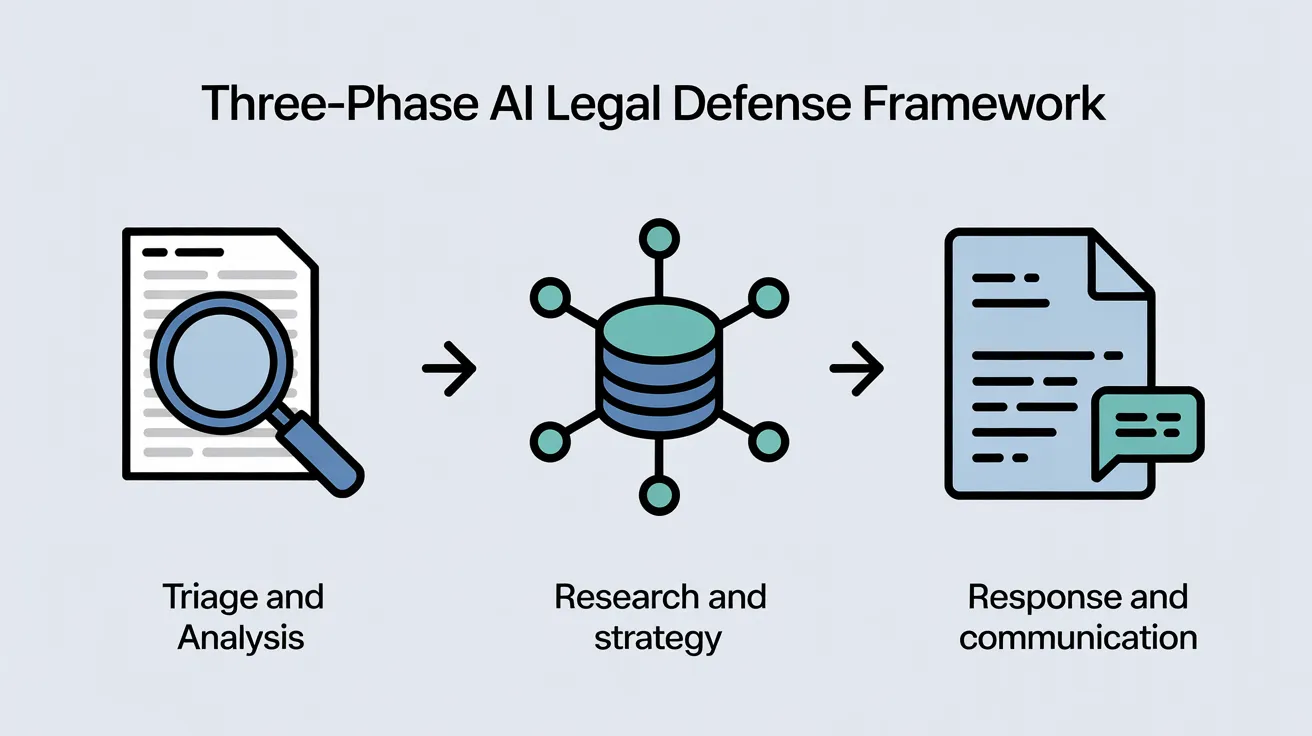
Implementing AI for legal defense isn't simply blindly relying on a chatbot. It's about following a structured approach to analyze the threat, grasp your standing, and respond from a place of strength. This framework generally consists of three essential phases.
Phase 1: Assessment and Triage
To begin is to leverage artificial intelligence to comprehend exactly what you're facing. You can feed the legal threat or demand letter into an artificial intelligence platform and ask it to perform an initial evaluation. The aim is to answer several key questions:
- What is the main allegation
- What specific laws or regulations are being referenced?
- Has the party making the claim proven they're the true rights holder?
- What evidence did they submit?
- Are there any immediate red flags or warning signs within their submission?
This first analysis enables you to progress from feeling overwhelmed to having clear understanding. It gives a clear, unbiased summary of the circumstances.
Step 2: Analysis and Strategy Development
When you grasp the claim, the next step is to leverage AI to research your defensive strategies. For a copyright claim, you should ask the AI to analyze the four factors of fair use and how they apply to your unique situation. For a debt collection notice, you must direct it to outline the validation requirements under the Fair Debt Collection Practices Act (FDCPA). This step is about constructing your case. You are gathering the legal principles and facts that will establish the framework of your response. This is also where you can begin to spot the shortcomings in your opponent's position.
Step 3: Response and Engagement
Now that your research is complete, you can leverage AI to assist in drafting your letter. This isn't meant for generating an automated letter. Rather, it focuses on employing AI to assist your writing. You provide the key arguments and factual background, and AI helps structure them into a well-structured and polished response. Your letter should normally:
- Confirm receipt of their message.
- Express your position with clarity and brevity.
- Mention the applicable legal concepts that support your stance.
- Seek extra details and validation, when necessary.
- Maintain factual accuracy and avoid emotional language.
This methodical response shows the opposing side that you are thorough, informed, and ready to maintain your position. It immediately changes the dynamic from one of coercion to one of a thorough legal conversation.
AI-Powered Copyright Claim Analysis and Response
Copyright infringement issues stand as a major concern for digital enterprises. Organizations may incorporate a picture on their website, before encountering a hefty financial demand from an image rights holder months later. AI can be particularly effective for such cases.
Reviewing the Claim
An AI tool can aid in evaluating the legal demand. It can analyze the demand letter to verify if it includes proof of copyright ownership, a legitimate copyright registration, and a detailed description of the supposed copyright breach. Numerous legal notices from aggressive copyright enforcers are deliberately ambiguous and lack this vital documentation. As entrepreneur Tony copyright of LinkDaddy found out, artificial intelligence can be utilized to assess the merit of a copyright claim, enabling an effective defense against a $500,000 copyright lawsuit without legal representation.
Understanding Fair Use Principles
AI functions as an effective resource for exploring the legal concept of fair use. Fair use represents a legal concept that permits more info restricted usage of copyrighted material without authorization from the copyright owner. AI technology can support you comprehend the four factors of fair use and how they can relate to your case, offering you with the reasoning required to establish a strong defense.
Validating Debt Collections: AI-Enhanced Defense Strategies
A different sector where AI is showing remarkable results involves defending against forceful debt collection practices. The FDCPA offers business owners and consumers specific rights, such as the option to obtain debt verification.
The Significance and Value of a Validation Letter
A collection agency must provide you with documentation about the debt, known as validation details. When you write a debt validation letter, you are officially asking that the collector verify that you owe the debt and that they have the legal right to collect it. Numerous collection agencies, specifically those who acquire old debt, cannot provide this evidence. AI technology can support you in drafting a complete debt validation letter that asks for all the required documentation, such as:
- The original creditor's name
- The original account number
- An authentic copy of the initial contract with signatures.
- A complete listing of the purported outstanding balance.
Submitting a formal validation letter often stops a debt collector in their tracks. Should they be unable to validate the debt, they are not legally permitted to continue to try to collect it.
AI Legal Defense: Success Factors and Limitations
It is essential to be aware of the boundaries of AI in the legal field. AI functions as a learning and preparation resource, not a licensed attorney. Knowing the distinction between what you can manage on your own and when you require legal assistance is crucial for a effective defense strategy.
Situations Perfect for AI-Powered Defense
- Initial Threat Assessment: Reviewing legal demands and cease and desist documentation.
- Responding to Baseless Claims: Developing strategies against debt collection agencies and copyright harassers who use intimidation methods.
- Legal Research: Examining your legal rights and the legal principles relevant to your situation.
- Organizing Your Case: Organizing your documents and key points prior to meeting with a legal professional, potentially saving you thousands of dollars in billable hours.
When to Get a Lawyer Without Delay
There are certain situations when you shouldn't attempt a DIY legal defense. Upon being served with a formal lawsuit, you should hire a lawyer. Other scenarios calling for immediate legal counsel are as follows:
- Criminal charges.
- Official regulatory investigations by government authorities.
- Complicated legal cases that involve different parties across multiple jurisdictions.
- Major circumstances where the financial impact could ruin your business.
In such cases, the function of AI changes from a main protective tool to a support system. You can utilize it to become better informed and ready as a client, but you must have a professional specialist on your side.
Developing Your Legal AI Protection Resource Kit
Starting AI legal defense doesn't need a qualification in computer science. It essentially needs a desire to learn and connection to the appropriate tools. The core of your toolkit will be a powerful language model like ChatGPT or Claude, combined with an educational platform that delivers specific prompts and frameworks for common legal threats.
The Significance of Professional LLM Inputs
The success of any AI platform depends on the specificity of your instructions. A general prompt like "write a response to this demand letter" will result in a basic and potentially inadequate result. On the other hand, a targeted prompt will instruct the AI to conduct a thorough analysis and generate an answer grounded in specific legal principles. This explains why platforms that offer field-tested prompts and frameworks are so beneficial.
Real-World Examples: Small Businesses Taking Action
The remarkable story of Tony copyright, who successfully saved his business over $511,000 by utilizing AI to combat three major legal threats, represents a powerful illustration of what can be accomplished. But he isn't alone. Across the country, small business owners are realizing that they wield more power than they believed. They are implementing AI to challenge baseless copyright claims and force debt collectors to verify their debts. These victories are not merely about financial savings; they symbolize regaining a sense of control and declining to be victims of a system that has long been stacked against them.
Legal Defense: The Path Forward for Small Business Owners
The adoption of AI into the legal field is still in its early stages, but the trend is clear. The delivery of legal services is growing more attainable and cost-effective. The conventional guardians of the legal profession are facing disruption by digital tools that assist small businesses and individuals. This doesn't mean that lawyers will be replaced. It means that their role will evolve. They will have the opportunity to dedicate themselves to the advanced, intricate matters that truly requires their expertise, while technology handles the more basic and preliminary work.
Small business proprietors, this represents a welcome change. This indicates that moving forward, a legal issue won't necessarily be a cause for financial anxiety, but rather a problem to be solved methodically and strategically.
Taking Action: Getting Started with AI Legal Protection
For small business owners, it's crucial to understand AI legal defense is now, before you need it. Familiarize yourself with the tools and platforms that are available. Understand the basic principles of legal protection and financial recovery. By taking these proactive steps, you can establish strong defenses for your company. You can evolve from being a vulnerable business into a knowledgeable guardian of your business achievements.
Most Asked Questions
Is AI genuinely useful for legal defense, or is it merely empty promises?
AI functions as an essential instrument for legal defense, but it's crucial to understand its role. It cannot substitute for legal counsel. Instead, consider it a highly effective support tool for research and preparation. It assists in review legal documents, understand complex legal topics, and draft initial responses, all of which results in saving substantial resources. The key is to use it for preliminary defense preparation and to understand when to consult a human expert.
How do I choose between AI tools and legal counsel?
Leverage AI tools to perform the first analysis of legal threats, when crafting responses to what appear to be meritless claims (including those from copyright trolls), and for organizing your legal case. It's crucial to engage a lawyer without delay if you have been served with a lawsuit, encounter criminal charges, or are handling a complicated legal issue that might affect your business. A reliable guideline is: leverage AI for groundwork, but rely on a lawyer when litigating.
What is the potential cost savings when using AI for legal defense?
You can achieve significant cost savings. The initial legal review and demand letter response can cost thousands in lawyer fees. Using an AI-powered platform can reduce this to a fraction of the cost. Successfully addressing threats during this initial phase can save you tens of thousands. If you ultimately need a lawyer, AI-assisted preparation can minimize their billable time.
What limitations does AI face in legal applications?
There are multiple key limitations to AI. It lacks legal standing and cannot serve as legal representation. It doesn't possess the sophisticated judgment of a seasoned lawyer and might not comprehend the intricacies of individual legal situations. Moreover, it operates using its training dataset, which may not be current. Above all, artificial intelligence is limited to providing information and help, not legal counsel.
Are there legal implications when employing AI for document analysis in legal contexts?
Using AI to analyze and understand documents is completely legal. You are just utilizing a technological aid for research and preparation, comparable to using common digital tools like search engines and word processors. The critical legal boundary is that you must not present yourself as an attorney without proper licensing, and artificial intelligence cannot function as your legal representative.
6. What indicates if a legal threat is genuine versus simple intimidation?
This is an area where AI analysis becomes particularly useful. An authentic legal claim will usually be specific, include supporting documentation (like a copyright registration number), and come from a recognized law firm. A bullying strategy, on the other hand, is usually ambiguous, doesn't include evidence, and may contain aggressive or unprofessional language intended to pressure you into immediate payment. AI can help you recognize these danger signals.
How does the Fair Debt Collection Practices Act (FDCPA) safeguard my rights?
The FDCPA serves as a federal statute which regulates how third-party debt collectors. You are safeguarded against abusive, unfair, or deceptive practices. One of its most powerful provisions is your ability to request validation of the debt. If collectors are unable to verify your responsibility for the debt and that they have the right to collect it, they are required to cease collection activities. This is a crucial protection for business proprietors who may be targeted for questionable or outdated debts.